
Menu

  • Categories
    • Arts
    • Culture
    • History
    • Music
    • Philosophy
    • Society & Politics
    • Technology & Science
  • Collections
  • Tags
  • Institutions
  • Contributors
  • All Films
  • Random Film

About

excoursio is a free platform for immersive guided tours, turning one-time walkthroughs into lasting learning experiences. excours.io means culture for everyone, everywhere.

Stay tuned

  • instagram
  • facebook
  • linkedin
  • bluesky
  • mastodon
Richard Paulick’s career was a mosaic of contradictions — modernist Bauhaus ideals alongside socialist industrialism, avant-garde innovation woven into national architectural traditions. His life was marked by war, shifting ideologies, and forced relocations, yet his dedication to architecture never wavered. Paulick emerged as one of the most influential architects of the German Democratic Republic, breathing new life into war-torn cities like Dresden and Berlin, while also shaping the industrial landscapes of smaller East German towns. Remarkably, his work extended far beyond Europe’s borders, leaving a legacy in pre-communist Shanghai as well. The exhibition at the Bauhaus Dessau Foundation, a beacon of German avant-garde architecture, vividly captures Paulick’s lifelong quest for self-realization in the face of the political and social currents of the 20th century. Through his work, the complexities of personal and ideological resilience unfold, offering viewers a window into both the man and the turbulent world he helped to shape.The exhibition Forward to the Past: Yokoo Tadanori’s Road to Hanshan and Shide presents artist Yokoo Tadanori’s compelling new paintings, inspired by the Tang-dynasty (618-907 CE) Zen monks Hanshan and Shide, alongside key works from his extensive artistic journey. Responding to the profound global shifts beginning in 2020, Yokoo retreated to his studio, developing his “moro-tai” (obscure style) to portray Hanshan and Shide, celebrated for their tousled hair, ragged clothes, and hearty laughter. This collection reveals how an artist’s personal introspection during times of societal change can lead to an unexpected connection with historical figures and artistic renewal, inviting visitors to consider the enduring power of creative resilience across ages.Eloquent Simplicity in Wood and Fiber is an exhibition exploring the versatility of natural materials, presenting sculptural forms and functional objects that blend traditional expression with contemporary design. The display defines the distinct aesthetic sensibilities of the Cordillera Mountain groups, including the Ifugao and Kalinga, who have long used wood and fiber to create objects for both utilitarian and ritual purposes. Juxtaposed against these traditional items, the exhibition features contemporary works by notable voices like National Artist Napoleon Abueva and designer Claude Tayag, who utilize Philippine hardwoods such as narra and molave. Addressing the modern scarcity of natural resources, the project highlights how artists continue to create meaningful, practical objects. This presentation encourages visitors to appreciate the enduring beauty, tactile quality, and profound functionality inherent in the world’s simplest materials.As part of the Classics of Russian Photography program, MAMM presents the first large-scale retrospective of renowned contemporary photographer Vladimir Bogdanov. The exhibition features over 100 photographs from the Multimedia Art Museum, Moscow, highlighting his work from the 1960s to the 1990s. Born in 1937, Bogdanov’s artistic journey began during the Khrushchev thaw, a period that allowed artists to explore themes beyond socialist realism. This era marked a shift where humanism replaced official dogma, enabling photographers to capture the lives of ordinary people. In 1955, while studying at the Textile Institute, he joined the Leningrad photo club VDK, transforming his passion into a profession. His compelling images reflect a deep connection to Russian society and its complexities during a time of change.Sergiy Bratkov (b. 1960) is renowned for his radically unsettling and striking photographs that, beneath their vivid surface, present an unflinching report on societal conditions. Like other members of the “Kharkiv School of Photography,” his work over the past 30 years has focused on social photography. In spring 2022, the Ukrainian artist, who had been living in Moscow since 2004, emigrated to Berlin. His recent work, previously centered on outdated Soviet-era clichés and the brash new capitalism of post-Soviet Ukraine, has now been sharply refocused by the brutal realities of the ongoing war. In this exhibition, Bratkov presents new cycles of images and videos created since Russia’s invasion of Ukraine. The once ironic observer has transformed into a reflective analyst, confronting the horrors of war in his former homeland. His new works grapple with this trauma while resisting the pull of hopelessness.
Toggle sidebar & navigation
  • Categories
    • Arts
    • Culture
    • History
    • Music
    • Philosophy
    • Society & Politics
    • Technology & Science
  • Collections
  • Tags
  • Institutions
  • Contributors
  • All Films
  • Random Film
excoursio

Tag / Art and Body

Filtered (1)
Duration
  • Reset all ×
  • 30-59 min ×

Duration

1 post found

Show (1)
Cancel

Sort by Date

Tartu Art Museum Arts | Culture | Music
18+

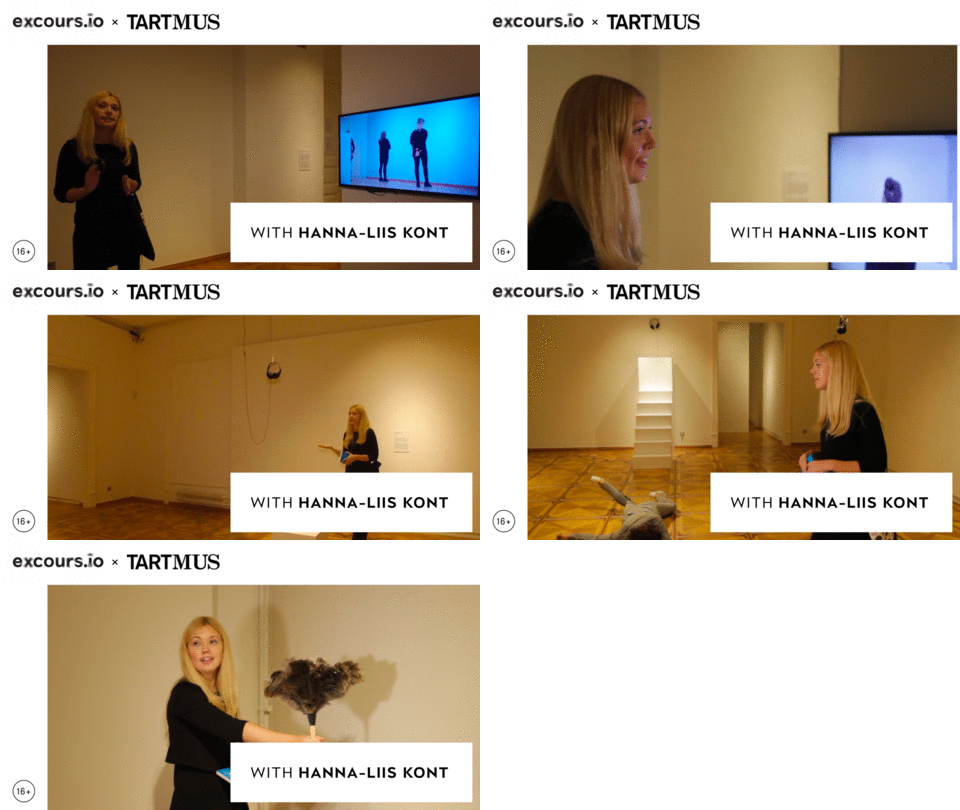
Museum Choreography

Muuseumi Koreograafia
Estonia Tartu 2018 53

This innovative exhibition reimagines the traditional museum experience through the lens of dance and choreography, inviting audiences to become active participants in the artistic dialogue. It foregrounds the unpredictable interplay between viewer movement and static artworks, showcasing how personal histories, cultural contexts, and physical presence transform the museum into a living, dynamic space. By exploring the nuances of how we look at and engage with art, the exhibition challenges visitors to reflect on their own movement and interactions within the gallery. This exhibition is a thought-provoking exploration of the embodied experience of art, making the viewer an integral part of the creative narrative.

Why should you watch this?

In today’s rapidly evolving cultural landscape, this exhibition stands out by positioning dance and choreography as vital means of understanding and engaging with art in the museum context. By centering the audience’s experience, it reflects our collective need for connection and interaction in spaces that often feel static and distant. In an era where individual perspectives and cultural backgrounds shape our understanding of art, this exhibition invites viewers to reclaim their role, reminding us that museums are not just repositories of art but vibrant environments shaped by human presence and movement. As the act of looking becomes more layered and complex in our digital world, this exhibition challenges us to reconsider our relationship with art, encouraging a deeper engagement that resonates well beyond the gallery walls.

Explore

  • About
  • Contacts
  • FAQ
  • Collaborate
  • Any ideas?

Network

  • Institutions
  • Contributors
  • Partners
  • Support us

Transparency

  • Accessibility
  • Sustainability
  • #GoodForEducation
  • Usage Policy
  • Cookies

Latest guided tour films

loader

By subscribing, you acknowledge and agree that we will store, process, and manage your personal information in accordance with our Privacy Policy.

Stay tuned

  • instagram
  • facebook
  • linkedin
  • bluesky
  • mastodon
  • Imprint
  • Privacy Policy
  • Community Guidelines
  • Jobs

© 2026 excoursio e.V. (non-profit). All rights reserved.